
'Given that the situation is quickly escalating, such attacks will affect the flow of crude in the short term from West Asia' Subhayan Chakraborty and Dhruvaksh Saha report.

The Indian couple was on a four-day cruise on the Spectrum of the Seas which was on the way back to Singapore from Penang on Monday morning when the 70-year-old Jakesh woke up to find his wife missing from their room.

The compulsion behind India and Japan to deepen security cooperation is in response to China's growing political and economic clout and its assertive behaviour in disputed areas. This has been the key driver for bringing both India and Japan closer in the domain of security cooperation, explains Dr Rajaram Panda.
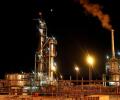
There is no payment problem for Russian crude, Petroleum and Natural Gas Minister Hardeep Singh Puri said on Wednesday. He said there is no proposal to cut retail fuel prices at the moment. Addressing a press conference, the minister said India enjoys a buyers' position and foreign suppliers are approaching Indian companies with offers to sell oil.
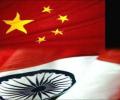
China has invited India to be part of its new initiative to build a Maritime Silk Road which it says is aimed at improving connectivity and trade among Asian nations through the sea on the lines of ancient Silk Route.

The unexpected missile attack on a second India-bound ship carrying Russian crude, just three weeks after the first, has complicated matters for domestic refiners. India now counts the Vladimir Putin-led nation as its biggest oil supplier, according to Paris-based market intelligence agency Kpler, and these attacks come on top of US sanctions since December, where vessels that bring crude to India are facing heightened scrutiny. Panama-registered Pollux, which loaded crude at the Sheshkaris oil terminal in the Russian port of Novorossiysk on January 24, was scheduled to deliver the medium, sour Urals grade to Paradip port on February 28.

India will kickstart on Tuesday a two-day multi-agency military exercise covering the country's 7,516 km-long coastline and exclusive economic zone with the twin aim of checking the preparedness of various agencies to deal with any eventualities and bolster overall maritime security, officials said.

China is also ready to promote high-quality Belt and Road Initiative cooperation, and push for new progress in the future-oriented, all-round friendly and cooperative partnership between the two countries, she added.

Singh emphasised that the Indo-Pacific is no more a maritime construct, but a full-fledged geo-strategic issue, and that the region is facing "a complex web" of security challenges, including boundary disputes and piracy.

The operation was jointly carried out by the Indian Coast Guard (ICG) and the Department of Revenue Intelligence (DRI) off Agatti coast in Lakshadweep, sources told PTI.

The Telecommunications Bill, 2023, which was passed by a voice vote after a short debate, also allows the Centre to take possession of a telecom network in case of any public emergency or in the interest of public safety.
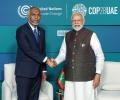
'India should respect Maldivian nationalism and their desire to be not over-dependent on India.' 'India should not behave like a big brother towards Maldives as many times, we tend to behave like that.'
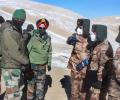
Lou also spoke about China's tensions with neighbouring countries without directly mentioning the eastern Ladakh border standoff with India since May 2020 which resulted in the Galwan Valley clash in June of that year.
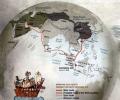
China's desire to have India as part of its ambitious Maritime Silk Route makes strategic sense for both nations. However, it would involve substantive assurances from Beijing, says Dr Rahul Mishra
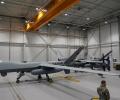
The Agency said it has delivered the required certification notifying Congress of this possible sale on Thursday.

Pakistan navy chief Admiral Noman Bashir on Friday claimed that there was no proof that Ajmal Amir Kasab, the lone terrorist arrested during the terror attack on Mumbai in November last year, had used the sea route to reach India's financial capital."We have consistent surveillance on the maritime border. There is no possibility that Kasab and his associates used the sea route from Pakistan," he told a press conference.

It is early to make out which way the wind is blowing, but there is no denying that challenges for the BJP, far outweigh the advantages in this region, notes Nilanjan Mukhopadhyay.
Prime Minister Manmohan Singh on Saturday pitched for a comprehensive maritime domain awareness scheme, as there were indications that terrorist groups are maintaining their ability to use the sea route.

'It will be important strategically and geographically because there is no port in India which is as close to the international shipping route as Vizhinjam.'
It said the acceptance of necessity accorded to the procurement by the Defence Acquisition Council noted the estimated cost of $3,072 million as provided by the US government, adding the price will be negotiated once policy approval from Washington is received.

India also went on an overdrive in expanding its military engagement with like-minded countries in its neighbourhood and beyond in the face of China's relentless attempts to become a regional hegemon and establish its primacy in South Asia.

Know the forts India has nominated to the UNESCO World Heritage list.

'Adani can attract vessels at a much lower cost to Vizhinjam as he has the financial muscle to do so.'
March 9, 2007, Defence Minister Antony cited intelligence reports to inform the Lok Sabha of the possibility that terrorists would use sea routes to enter the country. In his statement, Antony identified maritime terrorism, gun-running and piracy as major threats along India's seas, and said the government had worked out a menu of measures aimed at enhancing coastal security.

The Indian Navy has a big role to play in support of our strategic objectives in the Indian Ocean. The increasing Chinese presence in the Indian Ocean is a matter of concern and need to be factored. Hence, the requirement of an Aircraft Carrier is a foregone conclusion, asserts Commodore Venugopal Menon (retd).

While acknowledging Shivaji's naval contributions, questions are being raised about the inadequate acknowledgement of Chola sea-power in southern Tamil Nadu, which dates back by a few centuries, explains N Sathiya Moorthy.
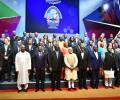
The pitch comes close on the heels of China launching its multi-billion dollar OBOR initiative

Industry officials say the crunch has not only affected manufacturing of edibles but even of items like nozzle pumps and other goods used in packaging.

Though dubbed as the "war hero", the role of Rajapaksa in ending the conflict with the Liberation Tigers of Tamil Eelam with the death of its supremo Velupillai Prabhakaran in 2009 is quite divisive as he stands accused of violating human rights, a charge he vehemently denies.
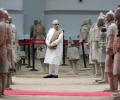
India, China must further strengthen business ties for growth.

China claims nearly all of the disputed South China Sea, though Taiwan, the Philippines, Brunei, Malaysia and Vietnam all claim parts of it. Beijing has built artificial islands and military installations in the South China Sea. Beijing is also involved in a maritime dispute with Japan over the East China Sea.
In all likelihood, the next conventional Chinese attack on India would be preceded by a massive cyber attack designed to cripple Indian networks and interfere with our disaster-relief programmes.
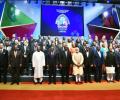
'During my visit to Japan and after meeting with Prime Minister (Shinzo) Abe, I gladly recall that in our joint declaration we mentioned Asia-Africa growth corridor and proposed further conversation with our brothers and sisters of Africa,' Prime Minister Modi said.

His remarks without naming any country came against the backdrop of tension between India and Pakistan after New Delhi revoked Jammu and Kashmir's special status.
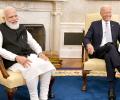
"This trip will advance the Biden-Harris administration's rock-solid commitment to a free and open Indo-Pacific," White House Press Secretary Jen Psaki said in Washington, DC on Wednesday.
'An area of land has already been earmarked for their protected habitation.' 'There are also steps being taken to take care of the coral zone and mangroves.'

The NCB has widened its probe into a recent seizure of about 50 kg of heroin from a house in south Delhi's Shaheen Bagh area with the arrest of three more people on Friday, officials said.
The Narcotics Control Bureau has seized about 50 kg of 'high-quality' heroin and arrested a man after it conducted raids in the Shaheen Bagh area of Delhi's Jamia Nagar, the federal anti-narcotics agency said on Thursday, claiming to have busted an Indo-Afghan drug-smuggling racket.

The Quad has come of age and its agenda covering areas like vaccines, climate change and emerging technologies makes it a force for global good, Prime Minister Narendra Modi said at the first summit of the coalition. In his opening remarks, he also talked about shared values and promoting a secure, stable and prosperous Indo-Pacific.
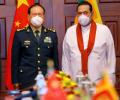
The Chinese have been making inroads in Sri Lanka where they recently got a reclaimed port city near Colombo. Prior to that, they gained control over the Hambantota port which was built by them.
 © 2026 Rediff.com - Advertise with us - Disclaimer - Privacy Policy - Sitemap - Feedback - About us - Terms of use - Grievances